
3 ml ampoules or a 30 ml serum bottle: how to dispense without guessing treatments
- 15 min reading time

A box of ten SYIS Vitamin Cocktail ampoules containing 3 ml each and an Apis Hyaluron 4D serum bottle containing 30 ml have the same nominal total volume. They are not the same working format. SYIS divides its product into ten individually opened glass ampoules; Apis supplies one bottle from which you dispense product on successive occasions. Choose by opening method, clean dispensing, the actual formula and the handling of leftovers—not by an invented number of facial treatments.
Choose ampoules if separately packaged portions suit your workflow and you can open glass safely. Choose the bottle if you want to adjust the amount taken at each use without breaking a fresh container. Neither one ampoule of 3 ml nor one bottle of 30 ml establishes a mandatory amount per face. Read the instructions for the exact product supplied rather than applying a general serum rule.
The liquids also have different compositions. The SYIS vitamin cocktail is not simply Apis Hyaluron 4D packed in smaller containers. This guide concentrates on the practical choice of packaging, hygiene and product waste. It does not prescribe medical treatments or promise comparative skincare outcomes.
1. Ten individually packed ampoules or one bottle?
SYIS Vitamin Cocktail 10 × 3 ml contains ten separate glass ampoules. Its current manufacturer listing gives an ingredients list and describes external application to cleansed skin of the face, neck and décolleté. SYIS suggests one ampoule can be sufficient for a complete treatment of those areas. That statement describes an example of use, not a requirement to empty one ampoule onto every face and not a scientifically measured number of applications for every person.
Apis Hyaluron 4D 30 ml is a concentrate in one serum bottle, identified on the official Apis website by manufacturer code 53525. The ordinary Hyaluron 4D must be distinguished from Hyaluron 4D with SNAP-8™ peptide and Hyaluron 4D + Lingostem™. Similar product names and matching 30 ml capacity do not establish matching ingredients or instructions. Check the full variant name and the dispensing closure on the actual pack before you order or use it.
The practical difference is the container's lifecycle. An unopened SYIS ampoule is a distinct unit; when it is opened, its contents are exposed and the original factory closure is gone. An Apis bottle holds the remaining serum inside a repeatedly operated closure. Neither format proves that one product is automatically stronger, more sanitary in every circumstance or better value. All of those judgments would require more than a packaging comparison.
| Question | SYIS Vitamin Cocktail | Apis Hyaluron 4D |
|---|---|---|
| Units | Ten glass ampoules | One serum bottle |
| Nominal contents | 10 × 3 ml = 30 ml | 30 ml |
| Dispensing | Open an individual ampoule | Dispense repeatedly from one bottle |
| Formula | Vitamin cocktail; separate INCI | Four hyaluronan forms; separate INCI |
| Once opened | Follow instructions for that opened ampoule | Close properly; observe actual durability label |
| Number of uses | Not determined by package volume | Not determined by package volume |
2. Equal volume does not equal equal treatment yield
Thirty millilitres is a quantity of product, not a treatment schedule. The area covered, texture, application technique, product remaining on fingers or accessories and the instructions for the actual batch all affect consumption. Even two people treating the same part of the face may dispense different quantities. A calculation assuming that every skin session uses exactly 1 ml or precisely three drops would manufacture precision that the evidence does not provide.
Keep four figures separate: volume in the unopened package, volume removed from it, volume applied to the skin, and any remaining material that cannot be used appropriately. A glass ampoule may retain a little liquid around its opening; a bottle may retain some in a dropper or on a dispensing tool. Those examples explain why a simple volume division can mislead. They do not allow anyone to assign a measured percentage loss to these two exact products.
For a salon, a basic consumption log is more useful than theoretical yields. Record which product you used, the zones treated, how many previously closed ampoules were opened and when a bottle was put into service. Observations gathered in your own practice may help you decide when to reorder. They should not be republished as a universal dosage or as a guarantee that the next customer's skin requires the same amount.
3. Opening a glass ampoule without borrowing another brand's technique
Before opening an ampoule, identify the intended breaking point, any safety sleeve or tool recommended for that exact presentation, and the correct way to keep fingers away from a sharp edge. Wash your hands, prepare a clean working surface and have an appropriate receiving or application tool ready. Read the instructions supplied with the SYIS product. Do not assume that the colour ring, grip or break direction from a different ampoule system also applies here.
Do not force a glass container that is not opening correctly. If it breaks unevenly, the neck fragments or there is doubt whether glass particles entered the liquid, do not apply the contents to skin. Filtering through gauze, paper or a strainer does not independently prove the absence of tiny fragments. Isolate the broken glass from reusable skincare equipment and dispose of sharp material according to the relevant local rules.
The official SYIS information identifies glass ampoules and describes application to cleansed skin. It also refers to some equipment-based cosmetic procedures, but that wording is not a blanket authorisation for injections, needling or every device. A liquid cosmetic in an ampoule is not automatically an injectable product. This comparison covers external skincare only; use involving equipment requires the relevant current product and device documentation and appropriate professional competence.
Once the ampoule is opened, you no longer have its unopened, factory-sealed state. A makeshift stopper, tape or transferring a remainder into another bottle does not restore that condition. If you want to retain any opened product, seek a clear, exact-product instruction first. Do not treat a lack of verified storage directions as permission to invent an overnight or multi-day storage rule.
4. Dispensing from a serum bottle without contaminating the contents
With Apis Hyaluron 4D, the repeated dispensing operation needs attention. Read the closure on the particular bottle in your hands: a dropper, pump and cap are not interchangeable operating systems. If the bottle includes a dropper, avoid touching the tip to skin, fingers, cotton pads, treatment tables or other used surfaces. This helps reduce avoidable contact between the product that will return to the container and surfaces that have already been handled.
Take the appropriate amount onto clean hands or a clean implement where the product instructions permit it. Then apply the dispensed portion to the skin; do not return a used applicator to the bottle. Close the container properly when finished. If a tip is dropped, blocked or damaged, rinsing it with arbitrary tap water before putting it back in the serum is not a manufacturer-verified hygiene procedure. Follow the instructions for that precise closure and replace damaged parts if needed.
The official Apis page and its rear-label photograph identify Hyaluron 4D, code 53525, 30 ml and EAN 5901810003500. The pictured label directs a thin, even layer onto cleansed skin of the face, neck and décolleté, left to absorb. Allergy to any ingredient is a contraindication; store at room temperature. It gives no fixed drop count: a thin layer is not a universal number of drops or confirmation of the closure on every supplied batch. Check the pack you receive.
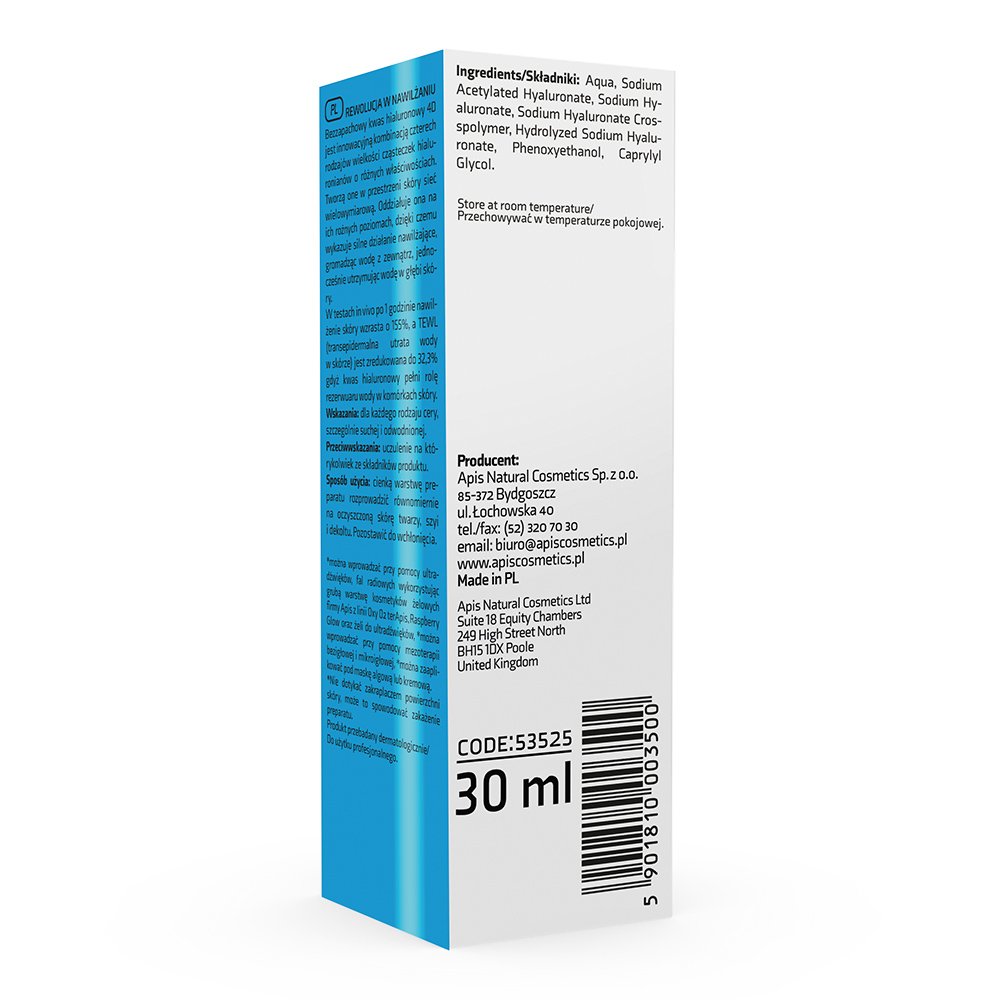
A bottle can be intended for repeated uses, but that does not mean the same exposed dispenser should touch several people's faces. In professional care, keep product dispensing separate from used skin-contact tools. This is a practical contamination-control principle, not a claim that any particular bottle is permanently sterile after opening.
5. Leftovers and the real meaning of expiry and PAO
An opened glass ampoule and a closed serum bottle are not equivalent storage systems. For SYIS, observe any exact instruction supplied for the opened ampoule. In the absence of a verified product-specific permission to store its contents after opening, do not invent a rule such as “keep it in the fridge for 24 hours”, “finish tomorrow” or “decant the remainder into a jar”. None of those steps automatically recreates the original factory packaging.
For Apis, inspect the actual bottle and carton for a minimum-durability date, batch identification, storage instructions and—where applicable—a period-after-opening symbol (PAO). Do not assign this serum three, six or twelve months simply because some other bottle bears such a symbol. European cosmetic labelling rules distinguish minimum durability from the period after opening where that concept is relevant. The EU cosmetics regulation explains the principles but does not set a product-specific period without its label.
It is reasonable to record the day a reusable serum bottle was first opened. Such a log reduces confusion if several salon staff members handle the stock, but it does not extend the product's permitted life. For ampoules, recording how many sealed units remain is a different inventory operation. Nine unopened ampoules do not make the remainder of the tenth, already-opened ampoule suitable for reuse.
Where a container has been poorly stored, shows an unexpected change or may have been contaminated, do not apply its contents merely to prevent waste. Do not attempt to preserve it by adding alcohol, heating it, diluting it or transferring it without manufacturer directions. For a specific uncertainty, obtain guidance tied to the actual label and batch rather than building a general home preservation method.
6. Packaging choice cannot replace an ingredients decision
The current SYIS Vitamin Cocktail manufacturer INCI lists, among other substances, Sodium Ascorbyl Phosphate, Panthenol, Niacinamide and Sodium Hyaluronate together with botanical extracts. Apis describes the regular Hyaluron 4D around four forms of hyaluronan. The products therefore cannot be interchanged merely because they provide the same total volume. If an ingredient matters because of a personal intolerance or preference, read the current complete ingredient list on the product you actually receive.
The Prohaar SYIS description also mentions vitamins A and E, retinyl palmitate and linoleic acid, while the manufacturer INCI consulted differs. This does not establish chronology or a confirmed formula change. Do not combine the lists into a new “complete” formula. Use the manufacturer list as the online reference and check personally relevant ingredients on the label of the version received.
Likewise, the Apis formula without extra wording is not the same as Hyaluron 4D + SNAP-8 or Hyaluron 4D + Lingostem. The older Prohaar article about Hyaluron 4D with SNAP-8 concerns identifying a different 30 ml product. It should not be read as the use, dosage or expiry guidance for the plain Hyaluron 4D bottle in this comparison.
Equal volume is not evidence of equal performance. No independent head-to-head study comparing these two exact SKUs under the same conditions was established. Claims that ampoules are invariably more concentrated, glass inherently increases absorption or one serum must produce faster results cannot be derived from this package comparison.
7. Choosing a format for home and professional routines
For home use, ask whether you actually want to handle a fresh glass ampoule at each planned occasion. If glass opening feels unsuitable or the workflow cannot be performed safely, a repeatedly dosed bottle may be more convenient—provided you want that Apis formula. Conversely, choosing SYIS can make sense if separate sealed portions are part of your intended routine. An ampoule does not need to look more “professional” to justify its purchase; it needs to fit your real use.
For a salon, distinguish the record “SYIS Vitamin Cocktail ampoule opened” from “Apis Hyaluron 4D dispensed from bottle”. Record where the clean dispensing tool comes from and how it is used. Keep product information at the workstation, but never let it replace the complete current label.
Store descriptions sometimes list ultrasound, infusion or other professional methods. External application to intact skin, using energy-based equipment and breaching the skin barrier are different categories of use. This article does not turn a liquid cosmetic into permission for microneedling or injections. Check the exact product and device instructions, qualifications and rules separately before considering any such procedure.
8. Final buying checks: model, handling and real use
First confirm the precise product name. SYIS Vitamin Cocktail is the 10 × 3 ml pack. The regular Apis Hyaluron 4D is a 30 ml bottle without extra SNAP-8 or Lingostem wording. Confirm the formula and the full ingredients list. A matching container volume does not imply an interchangeable serum, nor does a similar title establish the same manufacturer version.
Next confirm the actual opening and dispenser. Does the supplied SYIS pack show how to break its ampoules safely and whether a compatible opener is needed? What closure is fitted to the delivered Apis bottle, and how should it be kept clean? Current product photographs are aids to identification, not substitutes for the instructions supplied with your batch. If those directions are unclear, ask for the relevant version before proceeding.
Finally decide how you will handle leftovers before opening anything. Do not plan on preserving an opened ampoule unless the exact manufacturer guidance permits it. For the bottle, note its own storage and durability labelling. Check the current availability of either chosen product at Prohaar, because editorial content is not a real-time stock guarantee.
Compare the two product pages directly: SYIS Vitamin Cocktail 10 × 3 ml and Apis Hyaluron 4D 30 ml. For ingredients context rather than a dispensing protocol, see Prohaar's earlier introduction to niacinamide, retinol and hyaluronic acid. Do not use that guide’s general dosage suggestions as a protocol for these two products. The Prohaar skincare range can help you locate other formats, whose labels must be checked separately.
Frequently asked questions
Are ten 3 ml ampoules equivalent to a 30 ml serum bottle?
They are equal only in nominal total volume. They have different formulas, opening methods and usage arrangements. A matching 30 ml figure does not give them an identical number of applications or equal effectiveness.
Must I always use an entire SYIS ampoule in one treatment?
No universal obligation follows from the 3 ml capacity. SYIS says one ampoule may suffice for a full treatment, but the correct use of the exact presentation follows its instructions. That marketing statement is not an automatic storage rule for what remains.
Can the contents of an opened glass ampoule be saved?
Only follow explicit directions for that exact product. No universal post-opening storage time for the SYIS Vitamin Cocktail ampoules was independently established. Do not invent a refrigeration interval or transfer the remainder as though that reseals it.
What if I suspect fragments of glass after opening?
Do not use the liquid. An uneven break or possible glass contamination is not made safe by pouring the product through a cloth or strainer. Consult the specific opening instructions and dispose of broken glass safely.
How many drops of Apis Hyaluron 4D should I use?
30 ml does not establish a number of drops per use. The pictured Apis label specifies a thin, even layer on the cleansed face, neck and décolleté, left to absorb. Follow the directions and dispenser of the version received; do not convert bottle volume into a universal dose.
How long is the Apis bottle good for once opened?
Read the actual minimum-durability or PAO information where applicable. Do not infer a number of months from the bottle size or another serum. Recording the opening date is helpful, but the manufacturer's label governs suitability.
Is Apis Hyaluron 4D the same as Hyaluron 4D with SNAP-8?
No. The regular product and the peptide variant are separate models with different codes and formulas. A previous article about identifying the SNAP-8 version does not provide instructions for the standard bottle.
Buying decision: choose SYIS 10 × 3 ml for separate ampoules when opening and dealing with glass suits your routine; choose Apis Hyaluron 4D 30 ml for repeated dispensing of that specific formula from one bottle. Verify current ingredients, the closure, durability details and availability on the linked Prohaar pages. Primary references: SYIS manufacturer, Apis manufacturer and EU cosmetic labelling rules.
Prohaar editorial team · Product and source check: 14 October 2026. Instructions accompanying the actual product version take precedence.