
Grain-free enzyme peel or lava 2-in-1: choosing between two Apis products
- 16 min reading time

An enzyme peel without scrub grains is a different purchase from a 2-in-1 peel containing volcanic lava particles. The Apis Bio-Enzymes and Sea Algae Peeling, 100 ml, centres on papain and enzymatic exfoliation. The Apis Hydro Evolution Pear Peeling with Volcanic Lava 2-in-1, 200 ml, combines papain with particles that introduce a mechanical, rubbing component. If you want to avoid abrasive movements, the first formula is the more relevant starting point. If you intentionally want a granular scrub element, the second deserves consideration only when the skin is suitable for that friction.
The practical question is not which bottle promises the most dramatic glow. It is whether friction is desirable, how the skin is behaving now, and what the exact product label instructs. Prohaar's current listing for the lava 2-in-1 excludes acne-prone skin and couperose. Apis positions the sea-algae enzyme product for, among others, dry, sensitive and visible-capillary skin. Neither statement is a guarantee of individual tolerance, and neither turns a cosmetics comparison into treatment advice for a diagnosed skin condition.
This Prohaar Magazine guide looks only at those two verified products, their identifiers, texture concept, sources and practical decision points. The product and manufacturer information was checked by the Prohaar editorial team on 14 October 2026. No independent head-to-head clinical efficacy trial for these two precise formulations was identified; the comparison therefore concerns their intended modes of use and the limits of responsible exfoliation.
First identify the two Apis products, rather than comparing names alone
The Apis Enzymatic Peeling with Bio-Enzymes and Sea Algae 100 ml is listed by Prohaar under SKU 105379 and EAN 5901810000011. Apis identifies it on its official website as manufacturer code 50085, in the Hydro Balance range. Papain is the highlighted exfoliating ingredient; sea algae, aloe, green tea and several botanical extracts are also described. Its product identity does not require an intentional massage with abrasive grains to explain exfoliation. This is a description of the intended approach, not laboratory proof that the product cannot cause irritation.
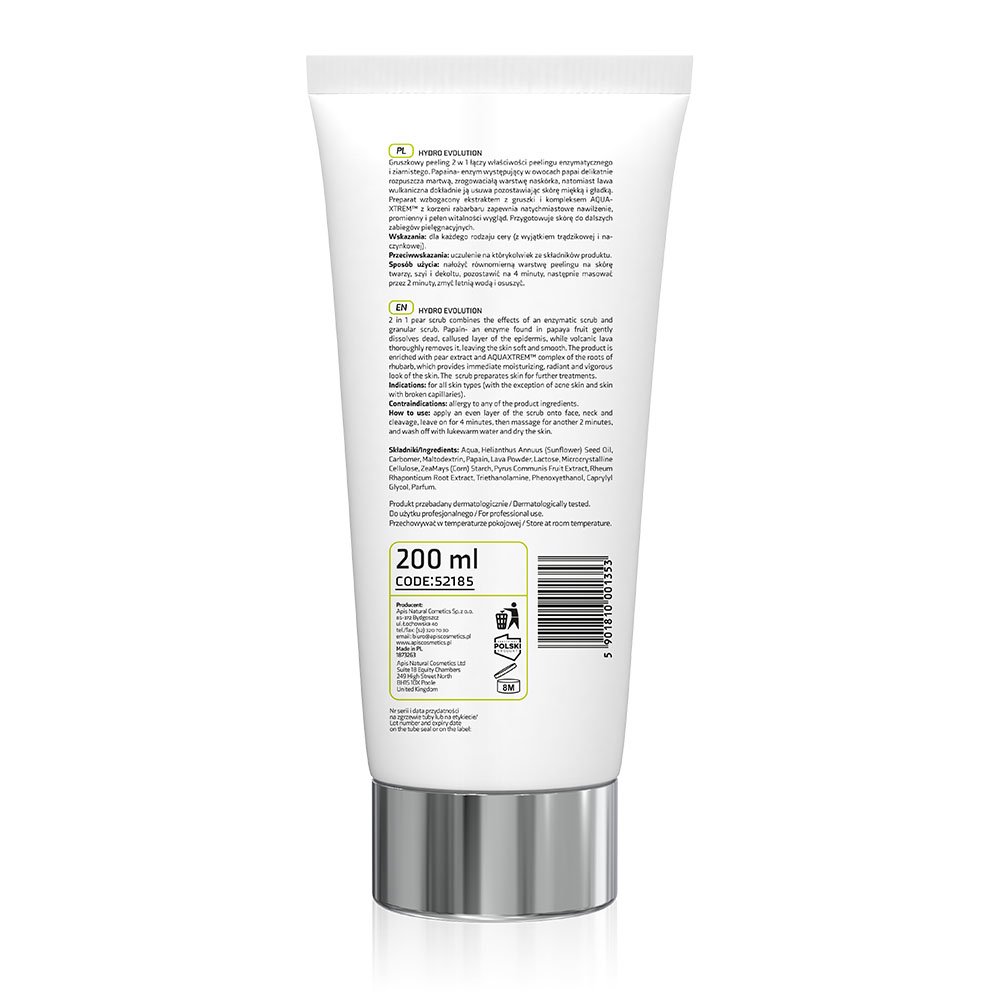
The Apis Hydro Evolution Pear Peeling with Volcanic Lava 2-in-1 200 ml has SKU 108619 and EAN 5901810001353. The manufacturer lists code 52185 and the Hydro Evolution range. Its official description explicitly brings together papain and grains of volcanic lava, alongside the pear-and-rhubarb AQUAXTREM™ theme. Lava is not simply an attractive label ingredient: it is the reason pressure and rubbing motions become relevant to product selection.
Both products contain an enzymatic component, but that does not make them interchangeable. One is presented as an enzyme-led peel; the other combines that approach with mechanical particles. The sizes, 100 ml and 200 ml, are different too, but twice the volume does not establish twice the effectiveness, number of applications or intensity. To calculate applications you would need verified use per session. To rank efficacy you would need credible, relevant comparative evidence rather than bottle size and marketing wording.
| Point to check | Bio-Enzymes and Sea Algae | Hydro Evolution Lava 2-in-1 |
|---|---|---|
| Prohaar SKU | 105379 | 108619 |
| EAN | 5901810000011 | 5901810001353 |
| Manufacturer code | 50085 | 52185 |
| Pack size | 100 ml | 200 ml |
| Type of exfoliation | Papain; no intended abrasive grain step | Papain plus physical lava grains |
| Core buying question | Do you wish to avoid scrub friction? | Can the skin tolerate a granular element? |
| Important caution | Enzymes may still provoke reactions | Current Prohaar listing excludes acne and couperose |
What a grain-free enzyme approach actually changes
Papain is a proteolytic enzyme used in cosmetic products intended to exfoliate the skin's surface. In practical terms, a formula that relies on this mechanism does not ask you to achieve the effect through particles scratching or rubbing across the skin. That distinction matters to somebody who dislikes the sensation of a traditional facial scrub or who has previously noticed that rubbing causes discomfort. The better buying description is exfoliation without the deliberately abrasive stage, not a promise of zero reaction.
An enzyme is still an active ingredient in a complete formulation. The absence of scrub granules does not establish that every ingredient is suitable for every person, that the product is allergy-free or that redness is impossible. Stinging, itching, burning, marked redness and discomfort should not be interpreted as proof that a peel is working exceptionally well. End use and follow the relevant product directions when an adverse reaction occurs; seek professional help for severe or lasting symptoms.
Apis associates the 100 ml peel with dry, sensitive and capillary-prone skin. That manufacturer's positioning helps explain why someone may prefer an enzyme-led form to a granular one. It does not constitute medical approval for active rosacea, eczema, inflamed acne or broken skin. What your skin is experiencing today is more important than the broad category on a sales page. If the surface is sore, actively irritated or sunburned, the relevant choice may be not to exfoliate at all.
Avoid treating phrases such as 'better absorption of serums' or 'instant rejuvenation' as measured outcomes for these two products. Manufacturer descriptions discuss cosmetic benefits, but a direct controlled comparison was not available for this editorial assessment. A useful guide should help a reader choose the mode of contact with the skin without inventing a ranking of results, concentrations or durability.
What volcanic lava adds to the 2-in-1 technique
In Hydro Evolution 2-in-1, the word 'enzyme' tells only part of the story. The manufacturer specifies both papain and volcanic lava grains. When grains move over the face, physical contact and rubbing become part of the exfoliating process. How the skin tolerates that contact can vary with pressure, amount of movement, skin condition and the full formulation. The exact current label, rather than a generic scrub tutorial, governs how the particular product should be used.
It is tempting to assume that more massage means a better result. This is an unreliable and potentially harmful yardstick. Skin becoming bright red is not a quality check, and deliberate force is not justified by the term '2-in-1'. Prohaar's current product page specifically says the lava option is not suitable for acne-prone or couperose skin. This restriction should be retained when giving advice about the model, while recognising that the manufacturer's general web description is not a complete personalised skin assessment.
The presence of pear, rhubarb and AQUAXTREM™ does not cancel the mechanical aspect of the lava particles. Moisturising ingredients and a gritty exfoliating method can appear in the same formula; that does not prove that rubbing is harmless or that friction is needed by everyone. Nor does the combination of two methods automatically make the product more effective than an enzyme-only option. 'Two mechanisms' is a technical distinction, not a score or percentage improvement.
In a professional setting, ask whether the client has experienced redness with scrub products, whether there are current inflamed areas and what other exfoliating treatments or medicines are in use. These are screening questions, not a diagnosis. If the answers reveal broken skin, a recent aggressive treatment or uncertainty about suitability, a responsible professional can postpone exfoliation and seek appropriate clinical guidance rather than improvise around the product's limitations.
Deciding when friction should be avoided
Consider three broad situations. A comfortable, intact skin surface may allow a discussion about preferred texture and whether a scrub stage is wanted. Visibly reactive or persistently red skin warrants caution with added mechanical rubbing. Open wounds, cuts or sunburn are a reason not to exfoliate. The American Academy of Dermatology explicitly advises against exfoliating wounded or sunburned skin and recommends matching the method to skin type and existing skincare products.
Acne also needs careful terminology. A single blemish, an inflamed breakout and a medically managed acne condition are not interchangeable. This article does not supply an acne-treatment protocol, and the current lava listing's exclusion should not be circumvented by applying less pressure or altering the label’s timing. Couperose and persistent facial redness warrant similar restraint; the word 'enzyme' alone cannot establish safety for someone with diagnosed rosacea.
Before introducing any peel, review concurrent use of retinoids, products containing retinol, benzoyl peroxide and other exfoliating ingredients. The AAD notes that these can make the skin more sensitive, and adding exfoliation may worsen dryness or breakouts. That does not mean there is one safe 'stop your medicine for X days' rule. Do not alter prescribed medication on the basis of a magazine article; a clinician can advise where a treatment and cosmetic peel may conflict.
While a product is on the skin, increasing pain, burning or visible inflammation should trigger reassessment rather than harder or longer application. Respond according to the exact label and obtain professional assistance when symptoms are serious or persist. Some skin types tolerate exfoliation poorly even when a cosmetic is marketed for sensitive skin. Not buying an exfoliant for the moment is a valid, practical decision.
Application and removal: confirmed information versus label-dependent details
The official rear-label photo for Hydro Balance 50085, 100 ml (image version 04.25) specifies a thin layer on cleansed face, neck and décolleté, avoiding eyes and mouth. Massage gently and leave for 5–7 minutes, then rinse with lukewarm water. These directions belong to that identified label version, not every Apis peel, and do not justify continuing through irritation.
The official rear-label photo for Hydro Evolution 52185, 200 ml (image version 11.22) specifies an even layer on face, neck and décolleté: leave for 4 minutes, then massage for 2 minutes, rinse with lukewarm water and dry the skin. The same label excludes acne-prone and visible-capillary skin. This sequence is not interchangeable with the 5–7 minutes for 50085; harder or longer massage is not an authorised extension.
On receipt, match EAN, volume and current instructions against the pictured 50085 rear label, version 04.25 and 52185 rear label, version 11.22. Both labels list allergy to any ingredient as a contraindication: do not use the relevant product in that case. If packaging changes, follow the current instructions supplied with it. The label timings do not establish a universal weekly schedule; do not combine the peels on your own initiative.

An enzyme peel is not automatically interchangeable with a chemical acid peel, and a scrub containing particles cannot be treated as an enzyme-only product because it also contains papain. Such distinctions prevent the widespread mistake of borrowing technique from whatever 'peeling' article appears first in search results. If you cannot inspect the model-specific instructions, postpone the procedure rather than inventing one.
How this choice fits an existing skincare routine
Neither Apis product is simply a daily facial cleanser. A cleanser is intended to remove routine surface dirt and make-up, while a peel is a distinct, optional exfoliation step. Prohaar's previous piece on Farmona Pure Icon: cleansing versus peeling explains that product-category boundary. You do not need to swap a familiar cleanser for lava grains in order to have a complete skincare routine.
When deciding whether to add an exfoliant, list the other products already in use: acids, retinol, exfoliating toners, brushes and stronger treatments can affect how well the skin tolerates another step. Evaluate the full routine rather than checking just the new tube. The AAD describes frequency as something that depends on method and skin type; its advice is not an Apis-specific fixed timetable or permission to use both models together.
Changes are also easier to understand when they are not all introduced simultaneously. If several active products appear in the routine at once, it becomes difficult to establish which may have contributed to discomfort. Recent procedures such as intensive facial treatments or medically managed skin therapy require relevant personal aftercare advice. This shopping guide cannot replace those directions and does not recommend using a peel on newly treated skin.
Following a suitably completed exfoliating step, prioritise appropriate moisturising care and normal daytime sun protection rather than another aggressive active ingredient. We are not promising that either Apis peel will multiply the penetration of subsequent serums. That kind of outcome is not established by the information reviewed here.
Selecting and recording the right model in a salon
For a salon, an informed decision combines the pre-treatment conversation, inspection of the skin, exact product identity and a clear option to stop. Choosing the 100 ml enzyme-led formula is a coherent preference when clients wish to avoid grains. Selecting the 200 ml 2-in-1 is a deliberate choice to include a physical component, not an automatic upgrade. The larger bottle is irrelevant to whether the extra friction is advisable for an individual client.
A useful treatment record names the actual product, SKU, EAN, relevant label version and skin concerns raised by the client. Record what was done and what was observed, without turning sensations into claims of objectively 'deeper penetration', permanent improvement or clinical effectiveness. If unusual redness occurs, it should inform the next decision instead of being presented as a desirable performance sign.
The range distinction is worth recording too. According to Apis, the sea-algae bio-enzyme peel belongs to Hydro Balance; the pear-and-lava formula belongs to Hydro Evolution. Similar brand names are not enough for reordering, and a copied routine may belong to a different range. Check barcode, bottle size and current printed instructions before passing a treatment card to a colleague.
If you are still deciding what belongs in the professional assortment, browse Prohaar's skincare masks and scrubs collection alongside these two exact products. Choose based on the mechanism, need for rubbing and the skin condition you typically encounter, not generic adjectives such as 'natural', 'intensive' or 'deep'. Store availability and inventory figures change; this comparison does not promise stock or universal suitability.
Three purchase situations with distinct answers
You wish to avoid physical scrub friction. The Bio-Enzymes and Sea Algae 100 ml product is the more logical fit by method. It is positioned by Apis as an enzyme-based peel with papain, but that does not mean an irritated or wounded face should be exfoliated. The supported takeaway is 'no intended grain-scrub stage', not 'guaranteed safe for all sensitive skin'.
You specifically want an enzyme-and-granule combination. Hydro Evolution Lava 2-in-1 200 ml provides exactly that format. The lava particles matter in application, and the Prohaar listing excludes acne and couperose. If the skin is already reactive or the instructions are unclear, do not assume that a lighter massage automatically makes the product suitable.
Your skin currently stings, is sunburned, broken or recovering from a procedure. Neither bottle is the priority at that moment. Postpone exfoliation and consider appropriate professional advice. Choosing an enzyme rather than a scrub changes the form of contact, but does not override the need to avoid additional irritation. A safe non-purchase can be more useful than forcing a comparison of promised cosmetic results.
Before ordering, verify product name, EAN, size and the actual label. For broader context, Prohaar's older article on peels and exfoliation describes categories, but its general claims and frequency suggestions should not be copied into a model-specific procedure for these Apis products.
Frequently asked questions about enzyme peel and lava 2-in-1
Does the 100 ml Bio-Enzymes product really avoid mechanical scrub grains?
Its verified product description centres on papain rather than a grain-massage mechanism, which is the significant difference from Hydro Evolution with lava. This does not replace checking the full ingredients and feel of the current formula, nor does it guarantee that the product is non-irritating.
Can I use the lava 2-in-1 on acne-prone or couperose skin?
Prohaar's current card specifically excludes those skin conditions. Mechanical movement may also be unwelcome on inflamed or markedly red skin. Do not use this product as an improvised treatment for acne or rosacea; obtain appropriate professional advice if you are unsure.
Is it better to combine both formulas in one treatment?
No verified Apis procedure was found that would justify combining these exact formulas. Both are exfoliants and one introduces additional grain friction. Assess existing skincare and skin tolerance rather than layering the products because their bottle sizes and names differ.
How many minutes should the peel stay on, and how often should it be used?
The checked labels specify gentle massage and 5–7 minutes followed by rinsing for 50085; for 52185, first 4 minutes, then 2 minutes of massage, rinsing and drying. Check the version received. This does not establish a fixed weekly frequency for every skin type or authorise longer steps.
Does the 200 ml bottle deliver more or stronger treatments?
It contains more liquid than the 100 ml product, but the formulas and working methods are different. Volume alone provides no verified number of sessions, identical dosage or relative efficacy. Record genuine consumption only under the applicable instructions.
Is papain automatically suitable for sensitive skin?
No. A formula designed to work without abrasive particles can still provoke a response to an enzyme or another ingredient. Avoid exfoliation on open wounds and sunburn, and discontinue use appropriately if significant irritation develops.
Where do I check the real product codes and general safety guidance?
The official Apis Bio-Enzymes and Sea Algae page and Apis Hydro Evolution Lava page provide the manufacturer identities and EANs. The American Academy of Dermatology provides general advice about exfoliating safely. Use the current product label for the actual application and removal directions.
Final selection: choose the Apis Sea Algae Bio-Enzymes 100 ml when avoiding abrasive grains is the goal; consider the Apis Hydro Evolution Lava 2-in-1 200 ml only if the additional physical element is appropriate. Read the matching bottle label, and do not exfoliate actively damaged or irritated skin. Prohaar editorial team · products and sources checked 14 October 2026.